The Useless Prevail: Interview with Hong Kong Underground Band-Fa
23 July 2016
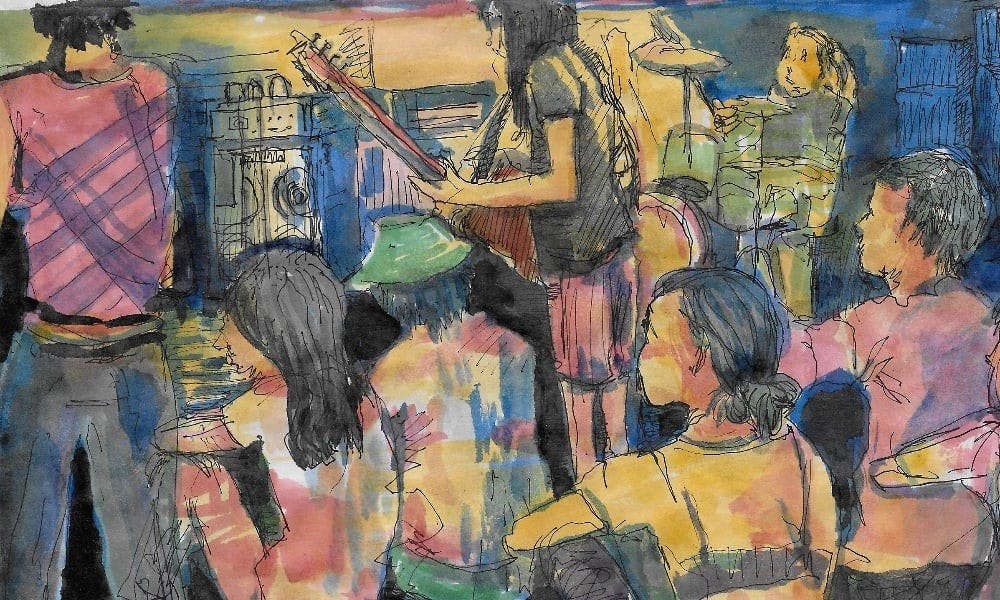
The “Useless” Prevail: An Interview with Hong Kong Underground Band “Fa”
Summary: As the younger generation in Hong Kong faces an increasingly oppressive political and economic climate, this article depicts how a group of artistic youths found space within the structural cracks to plant the seeds of thought and construct their own existential value.
Late at night, dragging my luggage, I stepped off the bus. After much struggle, I reached the entrance of the building, dodging puddles on the uneven pavement and failing to avoid the “warm” flying embrace of cockroaches.
My friend pressed the buzzer for a long time, peeping through the door crack. An weary-looking man of South Asian descent opened the door listlessly. He stared at my luggage with a suspicious gaze as he escorted us to the elevator.
The elevator doors opened. We walked toward a door plastered with torn scraps of paper and knocked. “Who is it?” a voice asked from inside. “It’s me! With a friend who just arrived,” my friend replied.
Dim yellow lights illuminated a completely foreign place. Several people were relaxing, sitting or lying down. Though it was pitch black outside, one could see row after row of windows through the glass. Clothes hung from the ceiling in various lengths. Music played. Despite a visitor’s arrival, everything seemed perfectly natural. People huddled together, smoking and speaking a language I did not understand.
After stowing my luggage, my friend and I joined the crowd. The smoke rose but refused to dissipate, as if we had crawled into a cave where time vanished. One space led to another; one graffiti tag connected to the next. We needed the memory of one image to link to another. Every song listened to led to more songs of the past; every poem written led to more past poems. Whether a stage or a home, it can never be isolated from the entanglements of reality. Instead, it is always crowded, leading to people, to other stages and homes, and to even more people. (Note 1)
Constructing Existential Value
The Hong Kong underground band Fa was formed in February 2014. It currently consists of five members: Derrick (Vocals), Klaus (Bass), Pat (Guitar), Tiv (Keyboard), and Cheuk-ki (Drums). Before the band’s formation, roughly between 2010 and 2013, the members lived in a semi-communal state. This was during a period when Hong Kong saw a surge in movements regarding land, spatial justice, and broader political activism.
Due to Hong Kong’s high property prices (Note 2), young people often rent affordable units in industrial buildings, sub-leasing them as studios or rehearsal rooms. This group was drawn together by shared space. The members of Fa (Note 3) experienced the pressure of eviction and, unwilling to “wail in solitude,” formed the band by chance, performing for the first time during their final days of bidding farewell to their space.
According to lead singer Derrick: “My understanding is that while the previous experiences of the members varied, we all felt the same ‘macro-rhythm.’ We went through similar lessons, shared similar feelings and corresponding attitudes—that was the foundation upon which the band was established.”
Derrick and Pat both had experience in other bands. Klaus, however, met the workers’ band “Lau” and other musical friends through his participation in social movements. At the time, they made a living as couriers. His experience in grassroots labor and learning an instrument from Lau’s bassist gradually sparked his desire to form his own band.
Klaus documented his work process through photography, hoping to let more people understand the experience of a courier. Speaking of that life, Klaus felt like he was living in “The Transporter.” In Tsim Sha Tsui—the heart of capital concentration—he and his peers raced to deliver goods, enduring the cold expressions of high-level office workers. He noted that while the wages were acceptable, the work was exhausting—8:00 AM to 8:00 PM. After dinner, he would collapse into sleep, leaving no room for a life of his own.
Resistance: A Window into the Control of Reality and Rules
The original space for these artistic youths was on the 3rd floor of a building in Kwun Tong, divided into various units for up to five bands to rehearse and create together. At its peak, the 6th floor housed the second generation of the music venue Hidden Agenda. Since 2010, the Hong Kong government has implemented “revitalization” policies for Kwun Tong’s industrial buildings, building waterfront gardens and swimming pools while converting industrial spaces into offices, retail, and leisure use. Consequently, by 2015, rents in the area had risen by 68% over five years (Note 4).
During this process, these young people resisted through action. On January 20, 2013, they launched guerrilla protests at the “Reverse the Flyover” opening ceremony organized by Energizing Kowloon East. They held rooftop parties in ruins and screened independent films outdoors. In December 2013, when Leung Chun-ying visited Kwun Tong, the group hung a nine-meter-long banner on a bridge reading: “International Neighborhood Warning: Beware of the Cultural/Creative Bulldozer.” Ultimately, in April 2014, the landlord reclaimed the land, and they were forced to move.
Earlier, some members were involved with the guerrilla radio station FM101. Operating from late 2008 to October 2011, this organization broadcasted via illegal FM and the internet. Its mission was civil disobedience, with diverse programming covering politics, current affairs, music, and art. The slogan of FM101 was “Civil Disobedience with a Party Heart.” (Note 5)
Regarding the radio experience, Derrick believes its impact was: “It made me realize there are many ‘mediocre people’ in this world who do nothing but sell or perform a certain identity to gain material or immaterial resources for pleasure. I don’t want to be that person, nor do I want to be an employee of a political group—the kind who earns a living while ‘contributing’ to society.”
“Reality is often watching motions pass unreasonably: urban management (Note 6), police power, and the expansion of capital show no signs of stopping. Meanwhile, you spend a lot of time photocopying, calling, and organizing events just to earn your salary for the next year. I don’t use a sense of powerlessness as spiritual food to pass the time, so once I realize it, I stay away from places where that powerlessness is heavy.”
Derrick, who reflects deeply on his own state, seemed to anticipate how his band would be quickly interpreted. Regarding the relationship between himself and social movements, he said: “Interviews might easily focus on our activist backgrounds and ask for details on how social movements relate to us. But what I discovered is that while social movements can be an entry point for revolution—allowing us to see the external world and understand human needs—they can also be the most troublesome stumbling block.”
“There is a lot of power and temptation in the details. The power games between groups and parties can easily make one feel they are doing something meaningful while completely losing their original intention and the vitality of imagining a better world. Over time, participants become ‘professional activists,’ creatures focused only on fighting for small gains on specific issues.”
“I think what needs to be emphasized is that while the coming and going of band members is deeply related to social movements, that is precisely the point we need to critique and break through.”
For them now, after experiencing the ups and downs of various relationships and movements, the most important thing is for each member to explore music and art and find a direction they want to work toward together.
Collective and Individual: Life at “9/F” and Self-Produced Music
“In an era where the sense of national belonging is collapsing, rave-like activities provide a sense of community, even if this is only a superficial phenomenon of the party.” — DIY Culture: Party and Revolution
After leaving Kwun Tong, they moved to a new collective space in 2015. Though people still come and go, the group has gradually shaped a tacit understanding of living together; the band is a microcosm of this group. Living together on the 9th floor and joining Fa, Tiv recalls: “Before I joined, Fa was an important part of the community, experiencing the changes alongside it. The songs completed before I joined are ones I love deeply. Our rehearsal space is also where we live. Members of the household often jam together. Later, when Fa rehearsed, I joined in and was ‘automatically’ added as a member.”
Drummer Cheuk-ki shares a similar sentiment: “Since living on the 9th floor, watching Fa play music felt great. I always hoped for a band with its own ideas. I started drumming when I joined Fa; nobody cared about technique—we just wanted to play.”
Klaus speaks on the process of releasing the album: “Looking back at the old songs, they were just segments of our early musical journey. Formally we were playing songs, but to me, those songs represented fragmented individuals; ‘Fa’ had not yet coalesced.”
“But after the change in members, it feels like we’ve found a direction to look forward to. Since Cheuk-ki was preparing to travel, we decided to release an album and tried recording on the 9th floor. It was through recording that the song ‘Playground’ took its final shape. I realized the first four songs were just the first stage—simple recording records. Now, our lineup can perform based on everyone’s emotions during live shows.”
Establishing a Language Against Capital and Authority
Regarding the origin of the album, Notes on the Flight from Babylon, Derrick explains: “Initially, we wanted to find shared feelings within our communal living and working space. If the people around us could identify with it, it would naturally become our external discourse and internal reminder. By producing more creations with more people, we complete our language. It’s not about the difference between Cantonese, Mandarin, or French; it’s about the fact that we must establish a language relative to capital and authority so that those contexts do not dictate our behavior. This is an ongoing project.”
“We have evolved from an atomized society to a state of extreme egoism. On this road to self-destruction, we discover that love exists in all things, though it is rarely expressed well among humans. It is hard to find because it is intangible; we want to talk about it because we crave it. We wanted to give a name to this thing we have been resisting, and we prefer to call it ‘Babylon’.”
The album was a collaboration between members and friends, designed with six interchangeable covers. Pat notes that among the tracks: “‘Wow’ was the first to be completed and is the most arranged. In the beginning, we discussed arrangements a lot—like ‘what should happen next’—but we’ve mostly abandoned that method now. For me, ‘Wow’ was a song where the music formed in my mind as soon as I saw the lyrics.”
“Squee-Squee” and “Shadow’s Farewell” are both memorials for late friends. “Squee-Squee” refers to whispering in someone’s ear. Klaus recalls: “It started when a friend living with us in Kwun Tong committed suicide. Derrick wrote the lyrics. Though the person is gone, we feel they are still close to us, not just in a three-dimensional sense.” Pat adds: “It’s a feeling of ‘crossing over’ the past—the kind where you must let go because the road ahead continues.”
The lyrics for “Shadow’s Farewell” are adapted from Lu Xun’s 1924 short essay. The shadow exists between light and dark, reflecting Lu Xun’s confusion and the feeling of having nowhere to go:
There is something I dislike in heaven; I do not wish to go there. There is something I dislike in hell; I do not wish to go there. There is something I dislike in your future golden world; I do not wish to go there. Yet you are exactly what I dislike. Friend, I do not wish to follow you; I do not wish to stay. I am unwilling! Alas, alas, I am unwilling; I would rather wander in nothingness. … I travel far alone, not only without you, but without any other shadow in the darkness. Only I am submerged by the darkness; that world belongs entirely to me.
Beyond the lyrics, Pat says of the tune: “It’s a kind of faith in skipping rhythms, believing they can be an extension of perpetual energy for humanity. The new song ‘Playground,’ finished on the 9th floor, has this feeling in the first half—using skipping rhythms to transform one’s state of mind, eliminate self-doubt, and then continue on the right path.”
So you take the essence of life The endless possibilities And offer them to convention and social morality They tell you to follow the signposts And you can obtain pleasure You can explore to your heart’s content Desire, Creation, Trash Advertisements, Production, Commands Buildings after buildings Advertisements, Systems, Machines, Numbers Rows after rows of railings — Excerpt from “Playground”
This echoes a line from Robert Lepage’s Needles and Opium: “Whatever you do, including love, life is like being on a train heading toward death, and opium is like letting you step out of the carriage for a while.” The lyrics of “Playground” seem to take us out of the carriage to look back at the train carrying us. Klaus describes “Playground” as “a critique of our own reaction, using a level of thinking very close to our own lives. ‘Playground’ is actually describing the appearance of the spectacle under this capitalist world.”
In 1993, an anti-road protestor in Yorkshire, England, ironically praised the right-wing government: “Perhaps we should thank Mrs. Thatcher most of all, because many of us activists are unemployed, took early retirement, or were fired, which is why we have the time to devote ourselves to protest.” (Note 7)
In the darkest places, even a faint light seems bright. It is precisely in Hong Kong—where land is scarce, people are crowded, and capitalism is deeply rooted—that “Babylon” seeks to keep people silent. Looking up, the sky is a geometric shape sliced by skyscrapers; the claws of cranes occupy even higher ground, and the noise of construction has become the daily background music.
On one hand, perhaps we should be grateful that Hong Kong’s current socio-economic state brought these youths together to share space, live together, and practice self-fulfillment. On the other hand, the music created by “Fa” is a microcosm of their collective life. As David Harvey replied to a scholar in China on why he uses abstract art like Balzac’s novels alongside empirical research: “These artists also live in real life… what artists do is present values that cannot be measured or carried by materiality… Money makes us feel we possess value, but money does not equal value. This applies to my daily life; my research has data on one hand, but I believe the immaterial is more important.”
For the band members, nothing is more important than being in a state of trust, using music as a language to share, express, exchange, and deepen thought. Regarding living and playing music together, Tiv’s realization is: “Seriousness, tenderness, liberation, and creation.”
Note:
- Ending adapted from Hong Kong writer Yip Si (Leung Ping-kwan), City of Memory, City of Fiction.
- How absurd are Hong Kong’s high housing prices? $510,000 USD for a 180 sq. ft. “mosquito house,” only slightly larger than a parking space.
- The original lineup consisted of Derrick, Klaus, Pat, and Dicky (drums). Derrick noted that while Dicky grew up near the band and FM101 circles, he never fully committed to any movement. A lack of shared “professional language” for deep communication led to their separation.
- Revitalizing Kwun Tong: How land and housing policies transformed a major industrial area.
- Reference from Wikipedia on “Guerrilla Radio FM101.”
- Derrick notes “Urban Management” refers to the Food and Environmental Hygiene Department (FEHD), which he likens to mainland China’s Chengguan, accusing them of maintaining a class-based streetscape under the guise of hygiene.
- Anti-road movement: Under Thatcher’s “Transport 2000” plan, commercial-government cooperation led to massive road projects like the M40, sparking protests from over 150 community and environmental groups. (Source: George McKay, DiY Culture: Party & Resistance, 2012).