“Where do we come from? Who are we? Where are we going?” Project
“Where do we come from? Who are we? Where are we going?”Project is co-creation by Print & Carve Dept. and Wenzaizun Community.
Series of activities
- 2025.04.25 - 2025.09.07 Exhibition〈Where do we come from? Who are we? Where are we going?〉, Reimagining Radical Cities, New Taipei City Art Museum.
- 2025 〈City Mandala: Fighting for Ideals〉
- 2025.02.28〈The Composition of Home〉workshop
- 2024.12-2025.2〈Iron Lady〉workshop
- 2024.07-09 Portrait Project with Residents at Wenzaizun
- 2025.08.02 〈Diverse Ecosystems of Cities:Principles of Great Cities〉Workshop
- 2025.08.03 〈Brave New City: One Thousand and One Dreams〉workshop
- 2025.08.16 〈Rights to the City: Let’s Dance the City Ballet Together〉Workshop


Introduction
“Where Do We Come From? Who Are We? Where Do We Go?” is a collaboration project between Print & Carve Dept. and Wenzaizun Community Development Association.(塭仔圳在地服務與發展協會)The works include 〈The Composition of Home〉, created in collaboration with residents of Wenzai Zhen through a workshop; 〈Iron Lady〉, created in collaboration with factory residents; and 〈The City Mandala Fighting for Ideals〉, the final piece created primarily by members of Print & Carve Dept.
〈Iron Lady〉features works produced with women who previously worked in factories at Wenzaizun. The term ‘Iron Ladies’ refers to these women who, balancing roles as homemakers and blacksmiths, demonstrated solidarity and self-reliance during past anti-eviction struggles. The artwork embodies their expression of inner strength.
〈The Composition of Home〉is a printmaking work created in collaboration with current residents of Wenzaizun, young people concerned about their hometown, and friends interested in urban values. Through discussions on the values of home, streets, and communities, and everyone’s ‘bottom-up’ planning imagination, it constructs an extended emotional identification with ‘home.’ Additionally, through D.I.T., it conveys the spirit of ‘needing to voice different perspectives and standing together to speak out.’
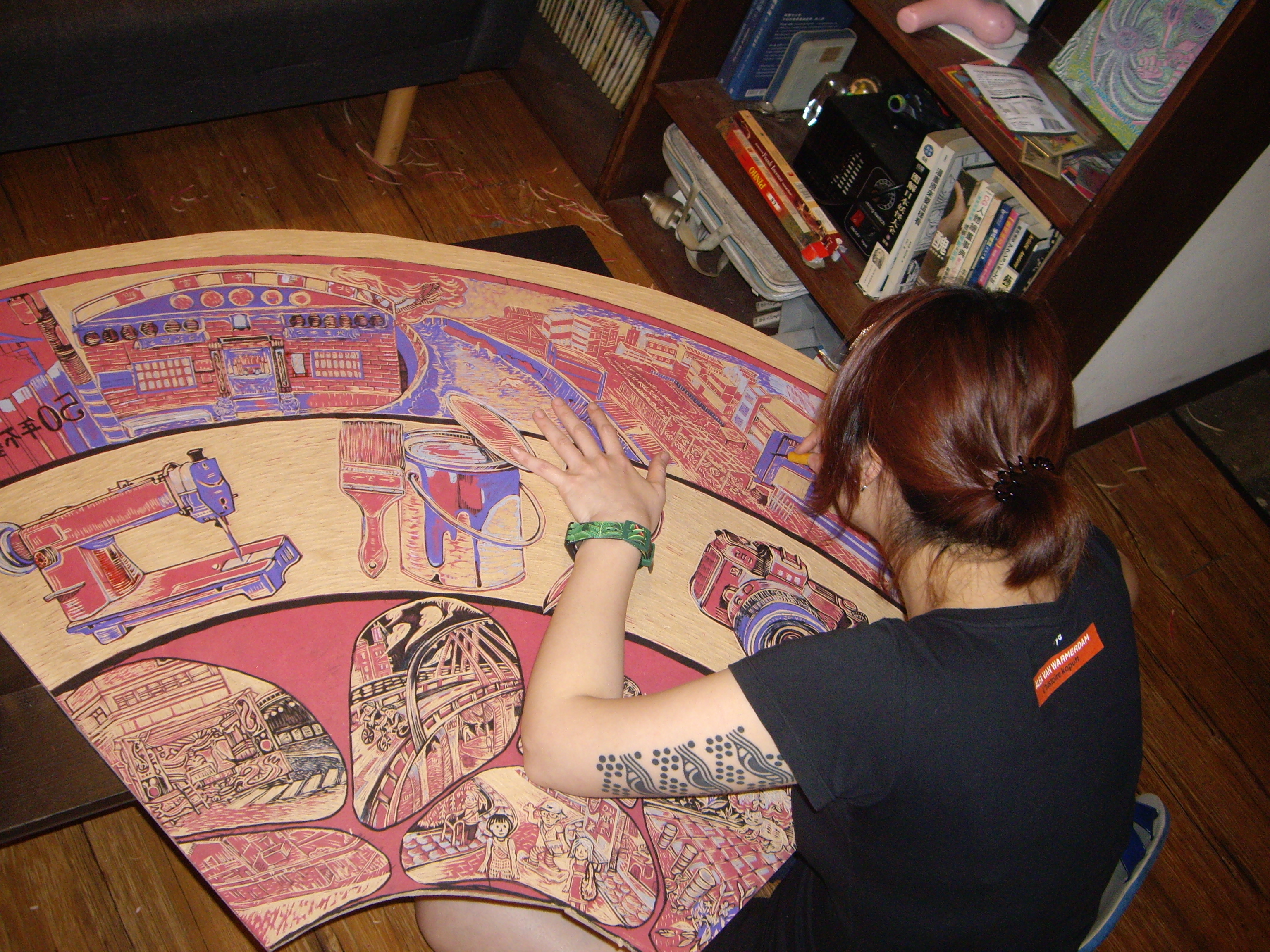
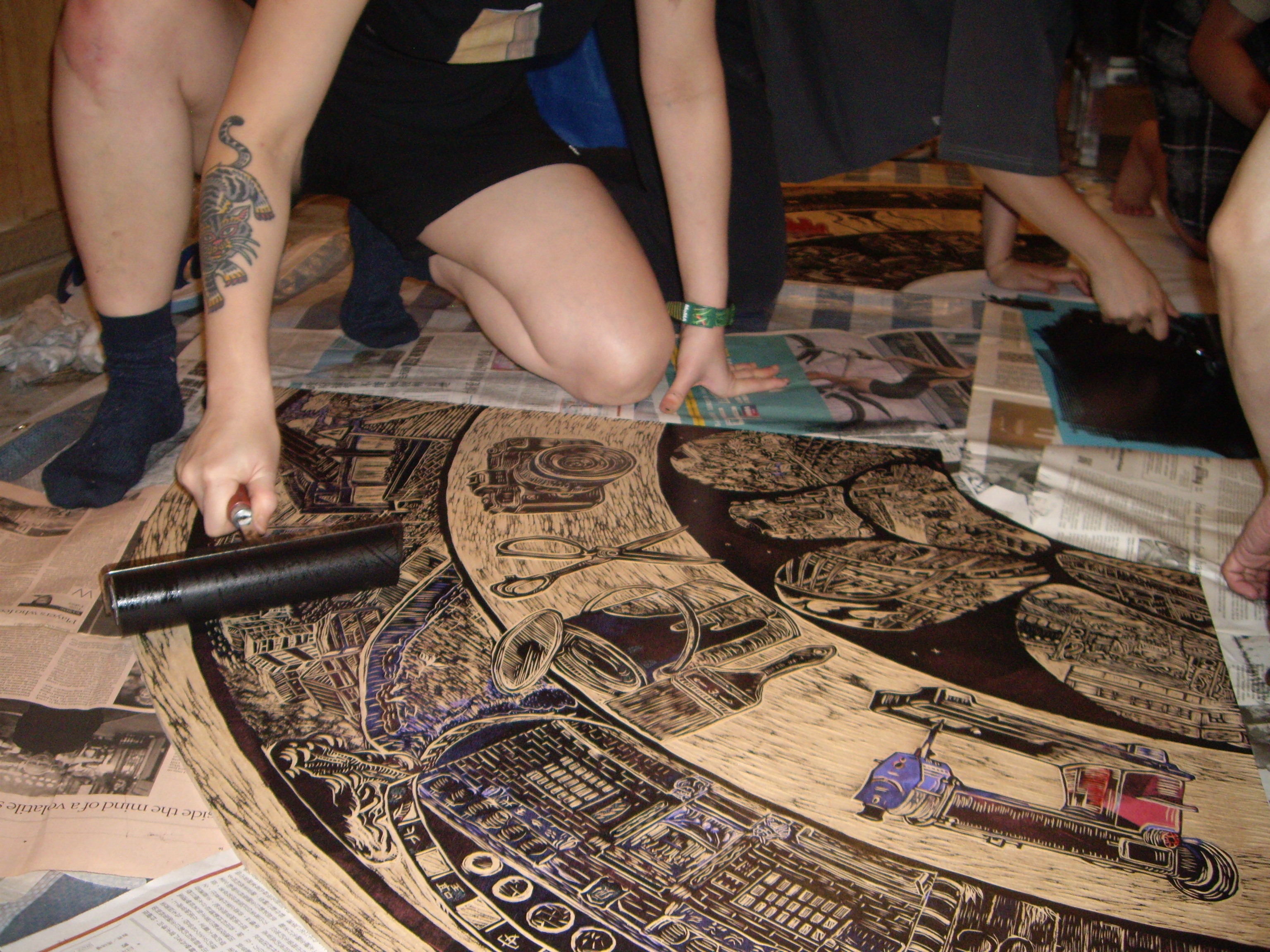
〈City Mandala: Fighting for Ideals〉 is a collaborative project between the Print & Carve Dept. and local residents, female blacksmith, and others, blending discussions and imaginings about the value of the city. The final work is composed of a community where ecology and humans coexist, scenes that emerge naturally like cells, and the diverse landscapes of the city unfolding like a scroll. Every detail conveys a urban space where people of different identities—the elderly, small business owners, farmers, workers, housewives, and others—can participate freely. It signifies that only when local voices are heard can an organic and inclusive ideal city come into being.
Following the completion of the exhibition Reimagining Radical Cities, three public engagement events were held in collaboration with the New Taipei City Museum of Art. These included workshops with community members, exploring different dimensions of the works within the Urban Mandala. The themes encompassed the city’s diverse ecosystems and the conditions that shape great cities; the poetic nature of the city; and how various public spaces and streets foster vibrant urban life. Selected works were also exhibited at the museum after completion.
2025 〈City Mandala: Fighting for Ideals〉

*Poetry
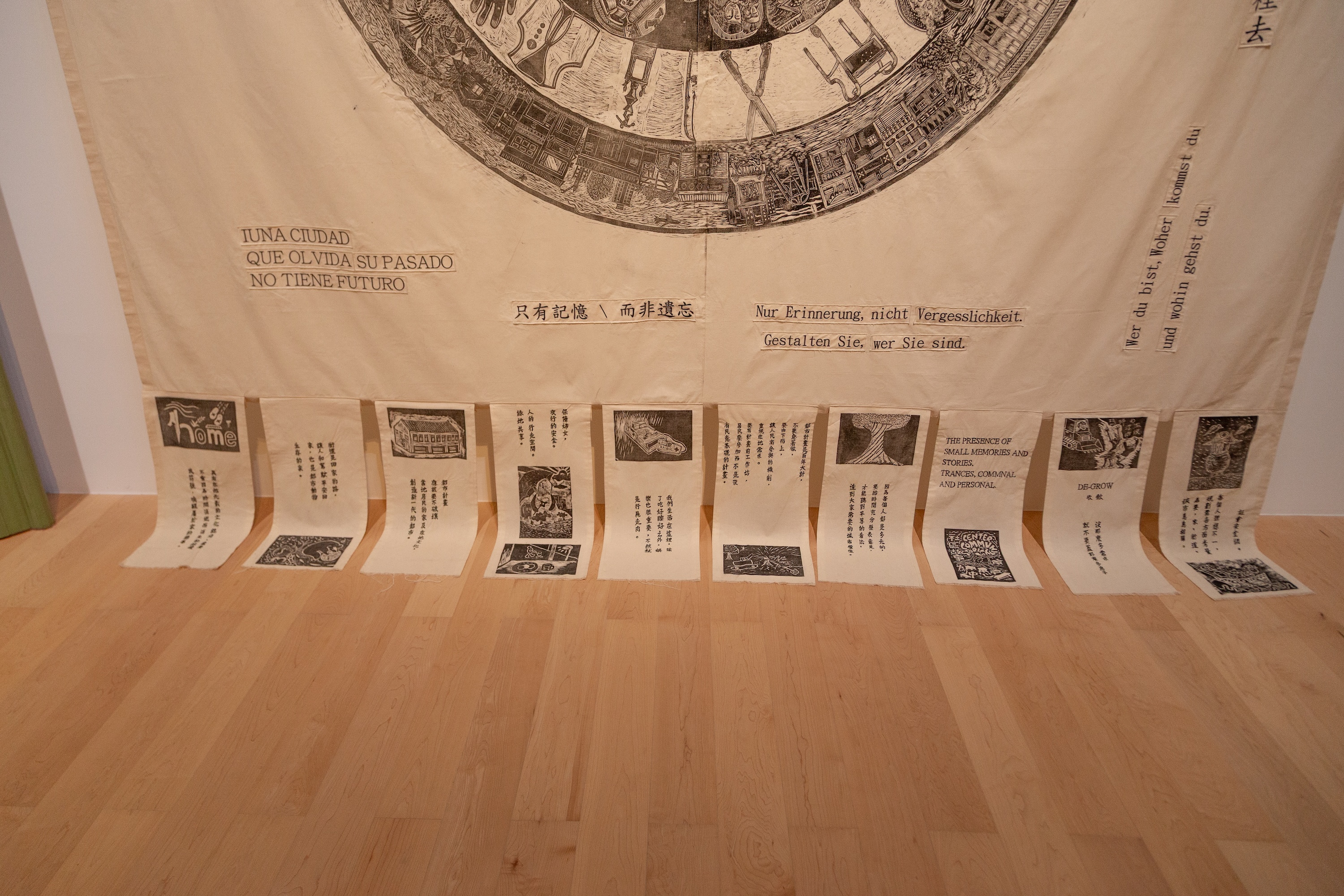
一座城市 A City IUNA CIUDAD 誰忘了她的過去 QUE OLVIDA SU PASADO ta 沒有未來 NO TIENE FUTURO 只有記憶/而非遺忘 Nur Erinnerung, nicht Vergesslichkeit. 能夠形塑你是誰 Gestalten Sie, wer Sie sind. 你是誰,Wer du bist 你從哪裡來,Woher kommst du 並知道往哪裡去…und wohin gehst du.
The poem in the work, with their variations in subject matter and language, symbolise different identities and an anti-capitalist resistance to urban space that knows no geographical boundaries.
The first three lines derive from a visit to the Duranguito neighbourhood of El paso, on the US-Mexico border, when Print & Carve Dept took part in an exhibition of Ensamblaje Enzarzado(2024). A mural of a local old lady’s resistance was painted on the wall, with the words ‘IUNA CIUDAD/ QUE OLVIDA SU PASADO/ NO TIENE FUTURO’. in Spanish. The latter passage is taken from a Spanish text.
The following passage is from one of the anti-eviction and cultural preservation movement in Taiwan: a comicstrip created during the preservation campaign of the Mitsui Warehouse in Beimen, which introduces the symbolism of the history of the Mitsui Warehouse building on the site, and ends with the lines: ‘Only memory / not forgetfulness / can shape who you are / where you came from / and know where you’re going’.
 ㄒㄛvvvv
The first Layer_Space - Community - People Composition
 The first Layer is the Core inner Circle, presenting the map of Wenzaizun are continuous streets, houses, surrounded by rivers and mountains, with a fisheye effect of this community in the urban landscape.
Bougainvillea, Feather Cockscomb, Camellia, Lewisia cotyledon, Iris, Graptopetalum mendozae, Hydrangeas, Chinese Moonflower, Hydrangeas, Chinese rose Flower, Heavenly bamboo and Rhodo are plants that we have seen in the fields, streets, parks, and gardens in Wenzaizun. There is a human figure in the center of each branch, representing that the community is made up of people.
Behind the flowers are the different creatures: ladybirds, fireflies, Mosquito fish ,butterfly dragonfly, common scaled water snake, formosan blue magpie, mandarin duck, rhinoceros beetle, grass carp, green-spotted triangle, and golden birdwing. Local elders told us that some of these animals are gradually decreasing in number or even disappearing, and they have also been living in this ecosystem.
The second Layer Organic urban scene
 A good urban plan allows people to interact naturally. Give people a better way to understand the place they live in.
The cell-like irregular outer wall symbolises the organic ecology of the urban landscape. Combined with our understanding of the lives of the residents of Wenzaizun, we have created 23 scenes of an ideal city based on the core concepts of ‘bottom-up’, ‘street ballet’, “feminism”, and ‘communal living’.
- A pavement with cats and malayan night-herons where people and nature coexist.
- A guerrilla performance using the public space under the viaduct.
- Streets that are safe for pedestrians, skateboarding, and the elderly.4. Riverside bike paths.
- Street-side Ke-Tse opera.
- Little egrets by the Ta-Liao-keng Creek next to Meihua New Village.7. The flat market. 8 Shared bookcases on the street.
- Teacher Tsai collected local stories about community history and geography and lead guided walks. 10.The daily life of the workers in the factory.
- Roadside stall.
- Snack stalls along the street.
- Long-Term Care migrate workers have their casual time while working. 14 Resident Yeh shared his early days of earning a living by searching for Gynura at Fu Jen Catholic University.
- Forest guarding.
- Local plant and flower bazaar. 17 Resident Uncle Chen joined a senior theatre troupe and performed at the National Elementary School.
- Resident Shi-En’s collection of old video games, comics and good wine.
- Resident Shuwen elected to be the mayor of the neighbourhood to promote the community.
- Maple Bridge Coffee’s owner and his wife chatting with customers.
- The Printing Department held a live printing event at the Meiwah Story House.
- Strolling around Brickyard Alley No. 1 with resident mr. Lu.
- Hsinchuang Community College organised the Centennial Vision Walk.
The third layer Tools for representing identity

Around 18 implements that represent identity or weapons against injustice. The urban programme cannot only see the national interest, but also the need to allow for the spirit of individuality and community.The 18 tools are:
- Hammer - It can be used to destroy and repair houses, and can also be a production tool in factories.
- Brick - the basic building material of a building.
- Gloves - Essential for workers and home renovations
- Election Vests - Residents have tried various ways to change the local political environment, including running for election.
- Trophy - The bowling trophy that residents uncle Chen share their interests and achievements in life.
- Fishing rod - Residents share their own recreational equipment, and go fishing at the beach to have their own adventures.7. Gardening shears - to take care of the beautiful gardens at home.
- Walking Aid - A good helper for the elderly to get around.
- Pan and fried rice - An essential tool for home cooking. In the past, residents have used fried rice as a way to protest against the government’s use of urban planning to drive up land prices.
- Books — The complete works of Marx’s “Capital: A Critique of Political Economy”, which are important to the young people who are struggling, as well as the spiritual food of the residents’ hard work and social concepts recorded, including “Goodbye,Wenzaizunin” , “Wenzaizun is my Neighbor”, and “Light Spot Story Collection”.
- Computer - a helper in spreading ideas, connecting relationships, and inviting people to participate in local activities.
- Loud Public - to let the voice from the bottom to the top be heard during the struggle.
- Screws - Material used to join objects together and hold them tightly in place. It is also one of the tools and materials produced by the Wenzaizun factory.
- Broom and dustpan - to clean up local streets and public spaces, the MCCC Storytelling Centre has been maintained by a number of joint clean-ups between students and residents.
- Tailor - used in the factories of Peihua plastic factory in the past, and necessary for family workers.
- Paint - material for repainting walls and protest cloth.
- Fabric scissors - for cutting protest fabric and printmaking fabric, sometimes needed for sewing old clothes or for home-based labour.
- Camera - to record precious moments, including local history and culture and the process of protest.
The fourth layer A city scroll including Wenzaizun
 The houses are connected in a circle by scrolls, symbolizing the ever-changing daily scene. Public spaces, residences and regional characteristics of Wenzaizunin, it also integrates the growth, destruction and regeneration of urban buildings. It is the accumulation of memories and life trajectories of people living here, and also carries the lives of residents into the future.
Tassels at the bottom ——〈The Composition of Home〉workshop works and words


2025.02.28〈The Composition of Home〉workshop
Our Workshop Preparation Process
The Wenzaizun Redevelopment Area, adjacent to Fu Jen Catholic University in Xinzhuang, was once synonymous with residents’ and factories’ resistance against forced evictions.
Residents who successfully resisted eviction remained and, alongside partners, have continued their efforts in this area. Amidst Wenzai Zhen’s rapid daily transformations, they strive to preserve the land’s original stories and convey a vision for shifting from eviction resistance to local service and development in Wenzaizun. Continuing to advocate for land and community participation, Print and crave dept. invites you to join residents in exploring visions of “home.” Exchange ideas and engage in discussions through printmaking and hands-on participation.

 (Order of works: From left to right, top to bottom)
-
Chen Xiaowen(陳曉雯) Snacks, convenience—food is the people’s priority. Residential planning must avoid spaces without even a single window. Road design should include streetlights, and surveillance cameras are preferable to ensure women’s safety when walking at night. Affordable store rents are needed to prevent large properties from crowding out small businesses.
-
Ye Jianzhong(葉建忠) Clean streets, trees, and electronic billboards can integrate local culture. Urban planning should avoid destroying residents’ homes and local culture while creating a new generation of cities.
-
Xiao Meng(小孟) Personal space, a functional kitchen, a beautiful dining table, flood control, shade, and temperature regulation. The street is the path home—ensuring people and drivers arrive safely, while also serving as a habitat for urban wildlife. Urban leisure and tourism extend beyond consumption and real estate towers; the city is an extension of home and identity. With beloved public spaces, there are more places to go.
-
Xu Shoujie(許守傑) Pond, Hometown Memories, DE-GROW, Convergence If there aren’t that many needs, then don’t build so many houses.
-
Tsai Tsunghsien(蔡宗憲老師) Warm, Sense of Belonging. Cultural identity rooted in local elements requires landmarks or symbols that endure beyond time, awakening a sense of belonging to home. This can be embodied in public facilities such as manhole covers, house numbers, and streetlights.
-
Lin Chienru (林倩如) Pets, books, bonds of life, freedom and safety, cultural action, accessibility. Urban ballet, diversity and inclusion, openness, sanctuary, third spaces, dialogue and connection, friendliness, self-governance, multifunctional community space redevelopment, social safety net. Cultural identity rooted in local elements requires landmarks or symbols that endure beyond time, awakening a sense of belonging to home.
-
Uncle Chen (陳叔叔) Living rooms require ample space, while streets and alleys must remain unobstructed in all directions, with a focus on traffic safety. As everyone’s ideals differ, planning must prioritize comprehensive consideration of all aspects, and homes, streets, and cities are all interconnecte.
-
Lin Yuting(林鈺婷) Doorbell, family. Coffee shop, space for people to walk. Shared green space.
-
Johnny Chang Photo Album、place to other memory->publication->small everyday stories. THE PRESENCE OF SMALL MEMORIES AND STORIES.TRANCES, COMMNAL AND PERSONAL. LISTEN TO AND EMBRACE LOCAL STORIES/MEMORIES OF MANY COMMUNITIES/INDIVIDUALS IN A WAY. THAT SUPPORT MANY DIFFERENT WAYS OF LIFE, SMALL SCALE, WELL CONNECTION,MAKED USE, SMALL PUBLIC SPACE.
-
Qiu Shuwen(邱淑雯) A home needs a lazy, daydreaming sofa and space to run and jump around. Roads and sidewalks must be convenient and safe, with bright night lights. Old trees and parks bring people together—people create warmth, memories, and joy. Urban planning is a century-long endeavor. Don’t rush it. Start from the bottom up, create mechanisms for public participation, and prioritize local needs. Hold pre-planning workshops—residents must be involved, not saddled with plans lacking public support.
-
Lu Kuanhsun(呂冠勳) Preserve the starfruit tree and the path by the gate—shared memories. “Respect for people” must be upheld both procedurally and substantively. Don’t rush to fulfill campaign promises; plans shouldn’t be rushed but require long-term vision. Because each person is multifaceted, ample time must be given for everyone to voice their opinions. Only then can we hear equal perspectives and achieve the urban values everyone needs.
-
Chen Shian(陳世安) Game consoles, fun. We live here, and besides eating well and sleeping well, entertainment is also important—otherwise we’d just be walking corpses.
2024.12-2025.2〈Iron Lady〉workshop
 From left to right are the individual creations of the three Iron Ladies: Jia Zhen, Shu Hui, and Xue Fen,and the second from the left is a collective creation by the Engraving Department.

-
Jia Zhen
 Her factory focuses on raw materials, showcasing the entire production process from raw materials to finished goods. Flanking the space are her family’s Shiba dogs and a kitten discovered hiding inside large machinery when they relocated from Wenzaizhen to their new location.
 -
Shu-Hui
 One hand holds a wrench, the other a spatula—symbolizing her dual identities as a skilled mechanic and homemaker. Above, the three most vital aspects of her life are depicted: sharing meals with family, attending meetings for the Wenzaizhen and advocating to the government, and maintaining the machinery at the factory.
 -
Xuefen
 The personal history of Wenzaizhen from past to present: from her childhood when her father still farmed the land, to her days as a factory sub-landlord cleaning the factory and forging deep friendships with blue-collar craftsmen, culminating in the current state of Wenzai Ditch after demolition.
2024.07-09 Portrait Project with Residents at Wenzaizun
From July to September 2024, Print & Carve Dept. visited eight groups of residents and relevant representatives, surveying their living spaces and surrounding environments in Wenzaizun. We conducted collective portraiture workshops and invited creators interested in the historical anti-eviction struggles of Wenzaizun to participate.
Through a series of processes including data collection, field surveys, personal interviews, story sharing, and painting creation, we fostered mutual understanding through collaborative creation and interactive sharing. The exhibited works encompass sketches, notes, photographs, and objects shared by residents that hold significant meaning in their life stories, all contributed by different participants throughout the process.
Portrait - Wu Junqi(吳俊奇)

 photo credit:yuling huang
Portrait - Chen Shian(陳世安)

 photo credit:yuling huang
Portrait - QIU,SHU-WEN(邱淑雯)

 photo credit:yuling huang
Portrait - Chen Wuyong(陳武勇)
 Portrait - Maple Bridge Coffee Couple(黃國璋、林瓊芳)

 photo credit:yuling huang
Portrait - YE,JIAN-ZHONG(葉建忠)

 photo credit:yuling huang
Portrait of the Iron Lady(淑惠、家甄、雪芬)

 photo credit:yuling huang
Portrait - LIU,RUEI-CHIN(呂瑞欽)
photo credit:yuling huang
Portrait - LIU,RUEI-CHIN(呂瑞欽)
 photo credit:yuling huang
2025.08.02 〈Diverse Ecosystems of Cities: Principles of Great Cities〉Workshop
Diverse Urban Ecosystems × Urban Resistance Aesthetics × The Mandala of the Great City
This session will introduce the collaborative process with residents of Wenzaizun, sharing the ideal urban landscapes envisioned within the Mandala of Urban Resistance. We will explore how to consider the diverse needs within a great city, inviting participants to engage in collective reflection and brainstorming. Through woodcut printmaking, we aim to create bottom-up principles for what constitutes a “great city.”
Group brainstorming and discussion:
“What qualities define a great city?”


2025.08.03 〈Brave New City: One Thousand and One Dreams〉Workshop
Writing Urban Memories × Reconstructing City Visions × Imprinting Collective Futures
In Calvino’s tales, each city is Marco Polo’s metaphorical narration to Kublai Khan—a composite of memory, desire, fear, and symbols. “Daring to imagine” is the first step toward creating the impossible. Let us speak openly of imagination, for within it lies the hidden potential of our cities. This session extends urban imagination through a different lens, inviting participants to draw from their personal urban experiences. Using language, bodily sensations, and creative expression, we will envision and imprint both personal and collective dream cities.
印刻部 2025/08/03 Brave New City Presentation

2025.08.16 〈Rights to the City: Let’s Dance the City Ballet Together〉Workshop
The Death and Life of Great Cities × The Body Imagination of Urban Public Spaces × Street Rhythms
Jane Jacobs’ “street ballet” describes the collaborative rhythms woven by countless strangers in everyday streets: neighborhood interactions, corner shops, children at play, elderly resting on benches—all spontaneous rhythms of life generated by citizens. This session begins with “The Body and Rhythm of the City,” inviting participants to observe, write, walk, and imprint their own experiences of the city’s bodily rhythms. Practicing urban ballet together is not only about perceiving bodily space but also about asserting urban rights.
印刻部 設計的 8/16 The Right to the city